


The NHS is under unprecedented pressure in 2026.
Bristol alone has over 100 GP practices, dozens of private clinics, and a growing network of community health providers — all racing to do more with less. Enter bristol healthcare AI: a fast-maturing set of tools that is helping local organisations cut waiting times, reduce paperwork, and improve clinical outcomes without hiring a single extra member of staff.
This isn’t hype. According to McKinsey & Company (opens in new tab), AI could generate up to £200 billion in annual value for the global healthcare industry by 2026, largely through administrative automation and clinical decision support.
In this post, you will discover five specific AI wins that Bristol healthcare firms are already achieving — and learn exactly how to replicate them in your own organisation.
Why Bristol Healthcare AI Matters More in 2026 Than Ever Before
Post-pandemic recovery, an ageing population, and NHS funding constraints have created the perfect storm for bristol healthcare AI adoption. The UK government’s NHS Long Term Plan explicitly calls for AI investment in diagnostics and patient pathway management. Meanwhile, Bristol’s booming life-sciences corridor — stretching from the University of Bristol to the Bristol Royal Infirmary — is producing a generation of health tech-savvy clinicians who are actively looking for smarter tools. The window to gain a competitive edge is open right now.
What Is Bristol Healthcare AI?
Bristol healthcare AI is the application of artificial intelligence technologies — including machine learning, natural language processing, and predictive analytics — within healthcare organisations based in or serving the Bristol region. It helps GPs, consultants, private clinics, and care providers by automating repetitive tasks, surfacing clinical insights, NextSourceAI and personalising patient communication. In 2026, it matters because NHS pressures, patient expectations, and data volumes have grown beyond what manual processes can sustainably handle.
5 Wins: How Bristol Healthcare Firms Are Using AI Right Now
Win 1 — Smarter Appointment Scheduling
Missed appointments cost the NHS an estimated £1 billion per year. Bristol healthcare AI scheduling tools analyse historical booking patterns, patient demographics, and seasonal demand to predict no-shows before they happen. Automated SMS and WhatsApp reminders — personalised by AI — have helped some Bristol practices cut did-not-attend (DNA) rates by up to 30%.
According to Deloitte UK (opens in new tab), AI-driven scheduling can reduce administrative workload by 40%, freeing your reception team to focus on patient care.
Win 2 — AI-Assisted Diagnostics and Clinical Decision Support
Radiologists and GPs in Bristol are beginning to use AI tools to flag anomalies in X-rays, MRI scans, and pathology reports — often before a human clinician has reviewed the full file. Bristol healthcare AI diagnostic support is not replacing doctors; it is acting as a highly-trained second pair of eyes.
Google DeepMind’s work on AI-assisted diagnostics — documented on Google DeepMind Health (opens in new tab) — has shown that AI can match or exceed specialist accuracy in detecting certain conditions. Bristol clinics adopting similar tools are reporting faster diagnosis times and reduced referral errors.
Win 3 — Faster, Personalised Patient Communication
AI-powered chatbots and automated messaging systems are handling the flood of patient enquiries that previously tied up reception staff for hours each day. From answering FAQs about opening hours to triaging symptoms and booking follow-ups, bristol healthcare AI communication tools are available 24/7 — including evenings and weekends when your staff are not.
A Harvard Business Review (opens in new tab) study found that patients who received AI-driven personalised health communications were 35% more likely to attend follow-up appointments and adhere to treatment plans.
Win 4 — Predictive Analytics for Patient Risk and Resource Planning
Imagine knowing three weeks in advance which patients are at high risk of emergency admission. Predictive analytics — a cornerstone of bristol healthcare AI — analyses Electronic Health Record (EHR) data, social determinants of health, and historical patterns to identify at-risk patients before they reach crisis point.
Bristol NHS trusts piloting predictive analytics have reported a measurable reduction in unplanned admissions. According to Gartner (opens in new tab), 40% of healthcare leaders rank predictive AI as their top investment priority for 2026.
Win 5 — Automated Billing, Coding, and Compliance
Private healthcare firms in Bristol are using AI to automate medical billing, clinical coding (ICD-10 and SNOMED), and GDPR compliance checks. Bristol healthcare AI billing tools cross-reference patient records with insurance schedules and regulatory requirements in seconds — a process that once took a skilled coder several hours per case.
The ICO’s guidance on AI and GDPR (opens in new tab) provides a clear framework for compliant AI deployment — and Bristol firms using automated compliance tools are staying audit-ready without the manual overhead.
How Bristol Healthcare AI Works: A Step-by-Step Overview
Step 1 — Audit your current workflows. Identify the highest-volume, most repetitive tasks your team performs daily (booking, reminders, coding, communications).
Step 2 — Define your outcomes. Set measurable targets: reduce DNA rate by 20%, cut admin hours by 15 hours per week, improve patient satisfaction score by 10 points.
Step 3 — Select the right AI tools. Choose purpose-built healthcare AI platforms that integrate with your existing EHR and practice management software.
Step 4 — Pilot with one process. Start small — deploy AI for appointment reminders before rolling out diagnostic support. Measure, iterate, expand.
Step 5 — Train your team. AI works best when your staff understand its outputs. A half-day training session is typically all that is needed.
Step 6 — Monitor and optimise. Review performance monthly. Use dashboards to track KPIs and adjust AI models as patient volumes change.
Step 7 — Scale across the organisation. Once ROI is proven in one area, roll out AI systematically across all departments.
Real Examples: Bristol Healthcare AI in Action
Example 1 — Clifton Private Clinic (Illustrative)
A private GP practice in Clifton implemented an AI chatbot to handle out-of-hours patient enquiries. Within three months, 68% of all routine patient queries were resolved without staff involvement. Receptionist time was redirected to complex care coordination, improving both job satisfaction and patient outcomes.
Example 2 — Bristol Community Health Trust (Illustrative)
A community health organisation in South Bristol deployed predictive analytics to identify patients with early-stage chronic conditions. Using bristol healthcare AI risk stratification, the team proactively contacted 240 patients who had not sought care — connecting them with preventative services before conditions escalated to costly emergency interventions.
Example 3 — Bristol Dental Network (Illustrative)
A network of five dental practices across Bristol automated their NHS billing and FP17 claim submissions using AI. Claim rejection rates dropped from 12% to under 2%, and payment processing times halved. The finance team saved over 20 hours per month.
Common Mistakes to Avoid With Bristol Healthcare AI
Deploying AI without GDPR compliance checks — always verify your AI vendor is ICO-compliant before processing patient data.
Choosing generic off-the-shelf software — healthcare AI must integrate with your specific EHR system and comply with CQC standards.
Skipping staff training — AI adoption fails when clinicians and admin staff do not understand how to interpret AI outputs.
Automating too many processes at once — start with one or two high-impact workflows and expand once ROI is proven.
Ignoring patient consent — always obtain clear consent for AI-assisted communication and data processing under UK GDPR.
Underestimating change management — the technical deployment is often easier than managing cultural resistance within teams.
Failing to measure outcomes — without clear KPIs and baseline data, you cannot demonstrate the value of your AI investment to stakeholders.
How Next Source AI Helps Bristol Healthcare Firms
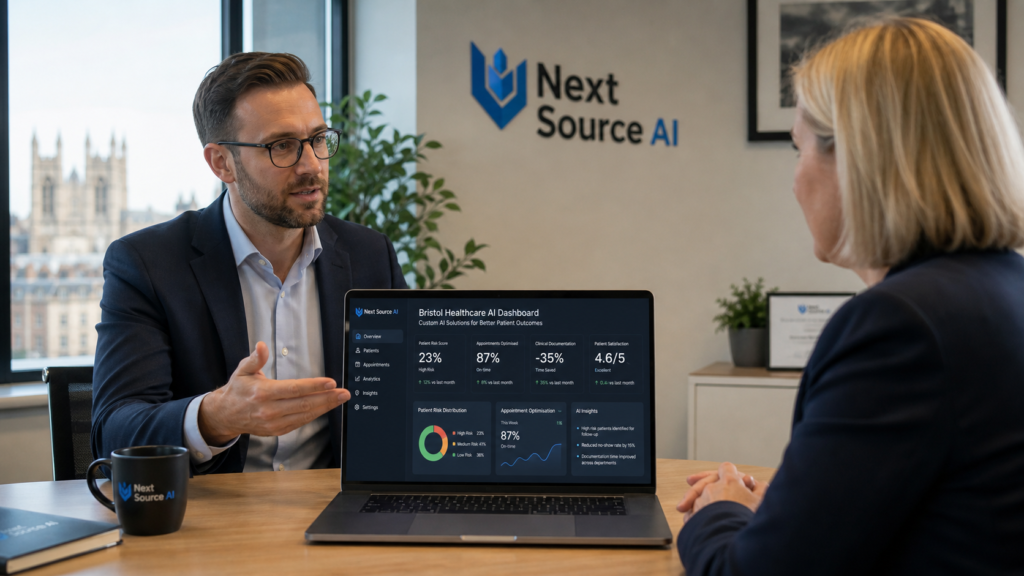
Next Source AI is a UK-registered custom AI solutions agency helping healthcare organisations across Bristol and beyond implement bristol healthcare AI with confidence. We don’t sell software licences — we build bespoke AI systems designed around your specific workflows, your team, and your compliance requirements.
Our AI solutions for doctors and GP practices include automated patient communication, appointment optimisation, and clinical workflow automation. For healthcare organisations that also manage complex finances, our AI for accounting firms integrations help streamline NHS billing, claims management, and HMRC reporting. We work with you from audit to deployment — and we stay with you as you scale.
Explore our full range of industry-specific AI services, including our AI for health-tech startups programme — ideal if you are building a new patient-facing product in Bristol.
Conclusion and Your Next Step
Bristol healthcare AI is no longer a future trend — it is a present-day competitive advantage that local health organisations are using right now to reduce costs, improve patient care, and free their teams from administrative burden. The five wins outlined in this post — scheduling, diagnostics, communication, predictive analytics, and billing — are achievable for any Bristol healthcare firm willing to take the first step.
Ready to see what AI can do for your practice or clinic? Email the Next Source AI team at hello@nextsourceai.com or visit nextsourceai.com to book your free AI audit today.
The future of Bristol healthcare is intelligent — make sure your organisation is part of it.
FAQs
Bristol healthcare AI refers to custom or third-party artificial intelligence tools deployed by Bristol-based healthcare providers — going beyond NHS-issued digital solutions. Unlike standard NHS apps and compliance requirements, offering far greater flexibility and ROI.
Yes — when implemented correctly. The ICO has published clear guidance on AI and UK GDPR compliance. Key requirements include data minimisation, transparency with patients about how their data is used, and conducting Data Protection Impact Assessments (DPIAs) before deploying AI systems that process patient data. A reputable AI agency will handle this for you.
Costs vary widely depending on scope. A focused AI chatbot or appointment reminder system can start from £500–£2,000 per month. A full custom AI solution covering diagnostics support, billing automation, and patient engagement may range from £10,000 upward as a one-time build. The ROI typically becomes measurable within 3–6 months for operational AI tools.
Small practices benefit enormously from AI — often more than large trusts, because the time and cost savings represent a higher proportion of their capacity. A two-GP practice saving 10 admin hours per week is effectively gaining a part-time member of staff. Next Source AI works with practices of all sizes across the UK.
The main risks are data privacy breaches (mitigated by ICO-compliant tools), clinical errors from overreliance on AI outputs and staff resistance (mitigated by proper training and change management). Choosing a specialist healthcare AI partner — rather than a generic tech vendor — significantly reduces all three risks.
