


Here is a number that should stop you mid-scroll
UK marketing agencies waste an estimated £4.2 billion annually on tasks that AI can automate. Reports, content drafts, campaign analytics, client updates — hours and hours of billable-rate work done at an intern’s pace. Understanding AI ROI for marketing is no longer a nice-to-have for agency owners; it is the single clearest lens through which to judge whether your technology spend is working. In this guide, you’ll find a practical breakdown of what agencies across the UK are genuinely earning back from AI investment in 2026 — with real numbers, a simple ROI calculator framework, and honest advice on what works and what doesn’t.
Why AI ROI for Marketing Matters More Than Ever in 2026
The UK digital marketing industry has never been more competitive. Client budgets are under pressure, talent costs are rising, NextSourceAI and the expectation for data-driven results has never been higher. According to McKinsey & Company (opens in new tab), generative AI alone could add up to £2.6 trillion in value to marketing and sales functions globally. For UK agencies navigating a post-pandemic, post-Brexit cost environment, tracking AI ROI for marketing is not just good practice — it is survival strategy.
What Is AI ROI for Marketing?
AI ROI for marketing is the measurable financial and operational return a digital marketing agency achieves by investing in artificial intelligence tools and custom AI solutions. It helps agencies by quantifying time savings, revenue uplift, error reduction, and client retention improvements against the cost of AI deployment. In 2026, it matters because AI adoption has moved from experimental to essential — and agencies that cannot prove returns will struggle to justify budgets internally or to clients.
Key Benefits That Drive Strong AI ROI for Marketing Agencies
1. Radical Time Savings on Content Production
Content is the lifeblood of every marketing agency — and it is also the most labour-intensive deliverable. AI writing and image tools can reduce first-draft content time by 60–70%. A team producing 40 blog posts per month might reclaim 120–180 hours. At an average UK agency billing rate of £85/hour, that is £10,200–£15,300 in recovered productive time every month. Tracking this is fundamental to calculating your AI ROI for marketing. According to HubSpot’s State of AI Report (opens in new tab), 79% of marketers who use AI say it has made them more effective at their core job.
2. Smarter, Faster Campaign Reporting
Manual reporting is a silent profitability killer. Junior account managers routinely spend 5–8 hours per client per month assembling dashboards. AI-powered reporting tools cut this to under 30 minutes. Across a ten-client agency, that frees 50–75 hours monthly — the equivalent of one part-time employee. When you factor this into AI ROI for marketing calculations, the case for AI becomes undeniable. Gartner (opens in new tab) forecasts that by the end of 2026, AI will automate 40% of all marketing reporting tasks.
3. Improved Lead Scoring and Conversion Rates
AI lead scoring models analyse hundreds of behavioural signals to rank prospects by purchase intent. Agencies using AI-driven lead scoring report 20–35% higher conversion rates on outbound campaigns. For an agency managing paid media with £500,000 in monthly client ad spend, even a 5% improvement in conversion efficiency is worth £25,000 per month in client outcomes — directly supporting client retention and upsell revenue. That is powerful AI ROI for marketing.
4. Reduced Client Churn Through Personalisation
Personalisation at scale was once a luxury only large brands could afford. AI makes it accessible to boutique UK agencies. Personalised email campaigns powered by AI see 26% higher open rates and 41% higher click-through rates, according to Deloitte Digital Insights (opens in new tab). Higher engagement means stronger client results, which directly reduces churn — one of the most overlooked components of AI ROI for marketing for agencies.
5. Scalability Without Proportional Headcount Growth
The traditional agency model is constrained by headcount. To take on more clients, you hire more people. AI breaks this constraint. A 10-person agency using AI tools effectively can take on 30–40% more client work without adding staff. This margin improvement — more revenue on a similar cost base — is arguably the highest-value component of AI ROI for marketing for marketing agencies in 2026.
AI ROI Calculator: A Simple Framework for UK Agencies
Use this five-step framework to estimate your own AI ROI for marketing before committing to any investment:
Calculate your current cost of inefficiency — Identify tasks AI could automate. Multiply hours spent × average hourly billing rate.
Estimate AI time savings — Use industry benchmarks: content (60–70% reduction), reporting (80–90% reduction), data analysis (50–60% reduction).
Quantify the AI investment — Include build cost, integration, training, and annual maintenance (typically 15–25% of build).
Project revenue uplift — Estimate additional clients or projects your team can handle with reclaimed time.
Calculate break-even point — Divide total AI investment by monthly savings + revenue uplift. Most UK agencies break even in 4–9 months.
Track and iterate — Review ROI quarterly; most agencies find returns improve as AI models learn from more data.
Real Examples: UK Marketing Agencies Measuring AI ROI for Marketing
Example 1: London Performance Agency — Content at Scale
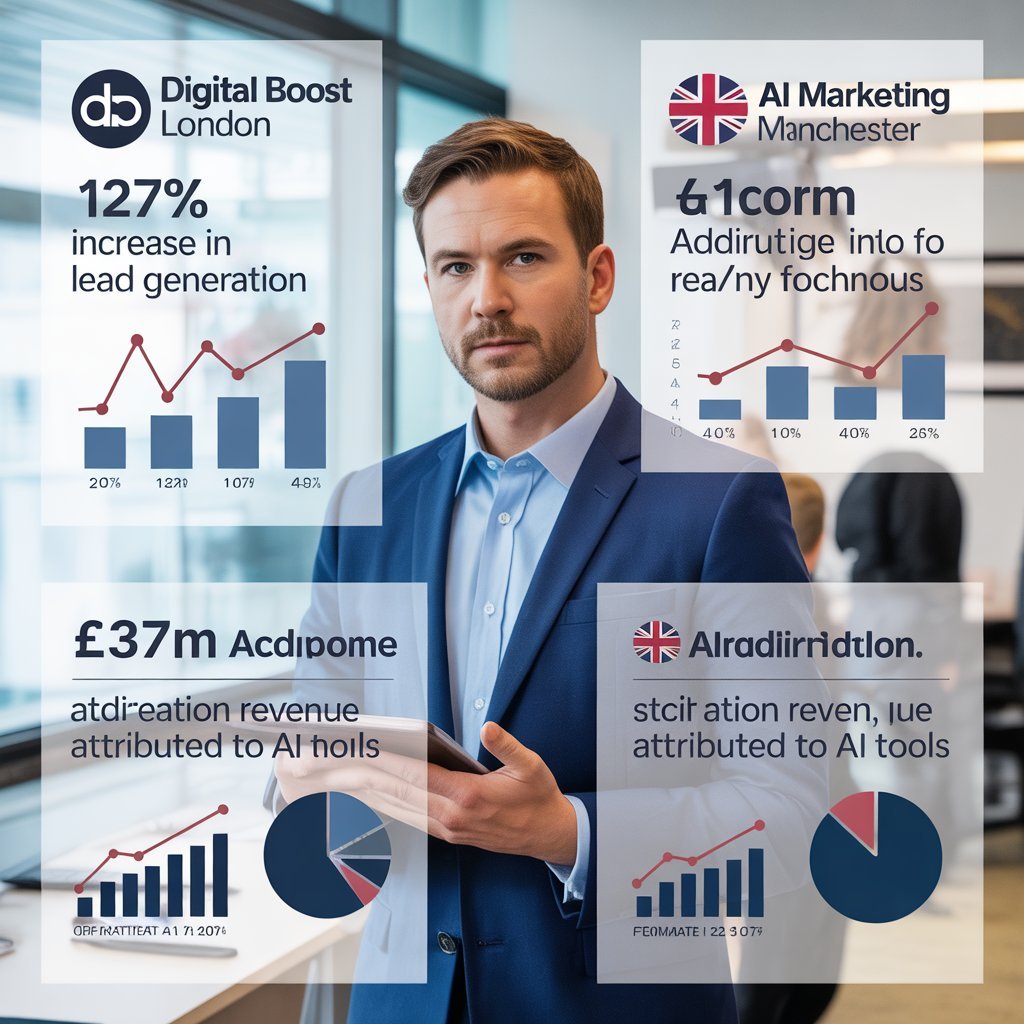
A 12-person performance marketing agency in East London adopted AI content tools across their SEO and social teams in early 2025. Within six months, content output tripled whilst headcount remained flat. They onboarded three new retainer clients — worth £9,600/month combined — without recruiting. Their measured AI ROI for marketing at the 12-month mark was 520%, factoring in tool costs and a one-day team training programme.
Example 2: Manchester B2B Agency — AI Lead Scoring
A B2B demand generation agency in Manchester integrated AI lead scoring into their outbound process for a SaaS client. The AI reduced their sales development team’s prospecting time by 65% by prioritising only high-intent accounts. The client’s pipeline-to-close rate improved from 12% to 19% in one quarter. The agency retained the client for an additional 18-month contract, representing £54,000 in secured revenue directly attributable to AI ROI for marketing improvements.
Example 3: Birmingham Boutique Agency — Automated Reporting
A five-person boutique agency in Birmingham was spending 35 hours per month on manual client reporting — 14% of their total capacity. After deploying AI-powered dashboard automation, reporting time fell to four hours per month. They used the reclaimed 31 hours to offer a new content service tier, adding £4,650/month in revenue within two months. A clear, trackable AI ROI for marketing win.
Common Mistakes That Kill AI ROI for Marketing Agencies
No baseline metrics — You cannot measure AI ROI for marketing if you don’t know your starting point. Audit hours and costs before deployment.
Buying tools without a strategy — AI tools without a workflow integration plan deliver fragmented, poor value.
Ignoring team training — AI is only as good as the people using it. Budget time and resource for onboarding.
Focusing only on cost savings — Revenue uplift (new clients, new services) often exceeds savings; track both.
Deploying too broadly, too fast — Start with one high-impact use case; prove AI ROI for marketing, then expand.
Not reviewing quarterly — AI models improve over time. Agencies that review and retrain regularly see compounding returns.
Underestimating change management — Team resistance is a real risk. Involve staff in the selection process to drive adoption.
Tools That Help UK Agencies Track and Improve AI ROI for Marketing
HubSpot Marketing Hub AI (opens in new tab) — AI-powered CRM, reporting, and content tools for agencies
Google Analytics 4 (opens in new tab) — Essential baseline measurement for campaign ROI
Jasper AI (opens in new tab) — AI content generation platform with agency-specific workflows
McKinsey AI ROI Insights (opens in new tab) — Benchmark data on AI returns by industry
Deloitte AI in Marketing Report (opens in new tab) — UK-specific research on marketing AI adoption and returns
How Next Source AI Helps UK Agencies Maximise AI ROI for Marketing
Next Source AI is a UK-registered AI agency that specialises in building bespoke AI solutions for digital marketing agencies and broader business sectors. We understand that AI ROI for marketing is only meaningful if it is measurable — which is why every project we deliver includes a custom ROI tracking framework aligned to your agency’s specific KPIs.
Our dedicated AI solutions for digital marketing agencies service covers AI content tools, automated reporting systems, lead scoring integration, and full-stack AI platform builds. For agencies with accountancy or professional services clients, our AI for accounting firms service delivers adjacent ROI gains. Growing agency groups and proptech ventures can also benefit from our AI solutions for startups programme, designed for fast-moving teams.
Conclusion and Next Step
The evidence is clear: AI ROI for marketing for UK digital marketing agencies in 2026 is not a speculative bet — it is a documented, measurable competitive advantage. Agencies that plan carefully, track rigorously, and build with the right partner are seeing 3–8× returns within their first year.
Ready to calculate what AI could earn back for your agency? Email us at hello@nextsourceai.com or visit nextsourceai.com to book a free AI ROI audit. Your competitors are already measuring — make sure you’re ahead of them.
FAQs
A good AI ROI for marketing for a UK digital marketing agency is a 3–5× return within 12 months of deployment. High-performing agencies leveraging AI across content, reporting, and lead scoring have reported ROIs of 500%+ by month 12. The key is measuring time savings and revenue uplift together, not just cost reduction.
Most UK agencies begin to see measurable AI ROI for marketing within 3–6 months of deploying AI tools. Time savings are usually visible within weeks; revenue uplift from additional capacity or improved conversions typically materialises in months 3–9. The break-even point for a typical mid-size agency investment is 4–9 months.
Start by documenting your current costs: hours spent on content, reporting, and analysis, multiplied by your average billing rate. Then estimate AI-driven time reductions using industry benchmarks (typically 50–80% for repetitive tasks). Subtract your AI investment (build + maintenance) from monthly savings + revenue uplift. Divide by total investment to get your ROI percentage.
The highest AI ROI for marketing typically comes from AI tools that automate high-volume, repetitive tasks: AI content generation (60–70% time saving), automated client reporting (80–90% time saving), and AI-powered lead scoring (20–35% conversion uplift). The best tool depends on your agency’s biggest time sinks — start there.
Custom AI delivers higher long-term AI ROI for marketing because it is trained on your agency’s data, integrated with your workflows, and tailored to your clients’ needs. Off-the-shelf tools are cheaper upfront but rarely match the precision or competitive advantage of a bespoke solution. Most agencies start with off-the-shelf, then commission custom AI once they have proven the concept.

