


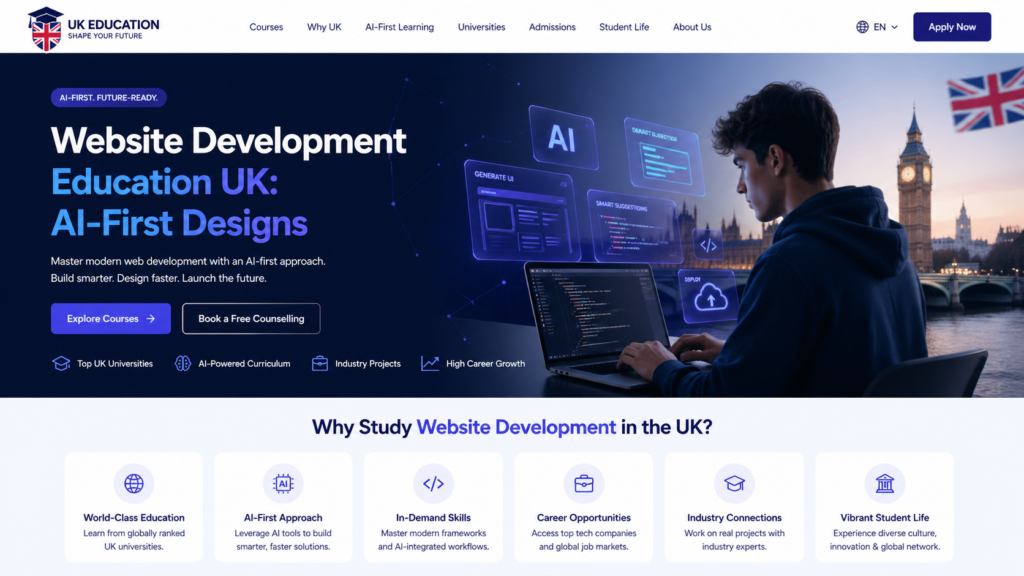
Did you know that 94% of a visitor’s first impressions of an educational institution are design-related?
For UK schools, colleges, and universities, your website is the front door — and that door is often creaking. website development education uk has evolved beyond a simple static presence. In 2026, prospective students and parents expect fast-loading, beautifully designed, AI-powered experiences that answer their questions before they even think to ask them.
Yet the majority of UK educational institutions are still running on outdated content management systems, NextSourceAI ,inaccessible layouts, and generic page structures that fail to convert visitors into enrolments. The result? Missed opportunities worth thousands of pounds in fees, grants, and funding.
In this guide, you will learn exactly what modern website development education uk looks like, why it matters in 2026, and how your institution can deploy AI-first design to attract and retain more students.
Why Website Development for Education Matters More Than Ever in 2026
The UK education sector is under intense competitive pressure. International student recruitment has rebounded post-pandemic, independent schools are battling for pupils, and state schools face increasing scrutiny from Ofsted. According to JISC’s 2024 Digital Experience Insights report (opens in new tab), over 80% of students now say a poor digital experience makes them question the quality of the institution itself.
What Is Website Development Education UK?
website development education uk is the process of designing, building, and optimising digital platforms specifically for UK-based schools, colleges, and universities. It helps educational institutions by creating accessible, mobile-first, AI-enhanced websites that drive enrolments, satisfy regulatory requirements, and communicate institutional values. In 2026, it matters because the competition for students is fiercer than ever and a high-converting website is the single most cost-effective marketing tool an educational institution can own.
7 Core Benefits of AI-First Website Development for UK Education
1. Higher Enrolment Conversion Rates
A well-structured education website guides prospective students through a clear journey — from awareness to enquiry to enrolment. AI-powered personalisation means each visitor sees content relevant to their course interest, location, and stage of decision-making. Research by McKinsey & Company (opens in new tab) shows that personalisation can lift conversion rates by 10–15% in service industries — and education is no different. For a university enrolling 500 students a year, that could mean 50–75 additional enrolments annually.
2. Improved Accessibility and Legal Compliance
UK public sector educational bodies must comply with the Public Sector Bodies Accessibility Regulations 2018. An AI-audited, WCAG 2.2-compliant site protects your institution from legal risk and ensures every prospective student — including those with disabilities — can access your content without barriers. Modern website development education uk integrates automated accessibility checks into the build process, not as an afterthought.
3. Superior Search Engine Visibility
Google processes over 8.5 billion searches per day. Parents and students searching for “sixth form colleges near Manchester” or “best independent schools in London” will find the institutions with the strongest SEO foundations. According to Statista (opens in new tab), Google holds over 91% of the UK search market. An education website built with technical SEO, schema markup, and AI-optimised content will consistently outrank competitors.
4. AI Chatbots That Answer Enquiries 24/7
Admissions teams are stretched. An AI chatbot trained on your prospectus, FAQs, and course details can handle hundreds of simultaneous enquiries — at 2 am on a Sunday — with the accuracy of a knowledgeable member of staff. This directly reduces your cost per enquiry whilst improving the applicant experience. Our AI solutions for education include bespoke chatbot integration as a standard feature.
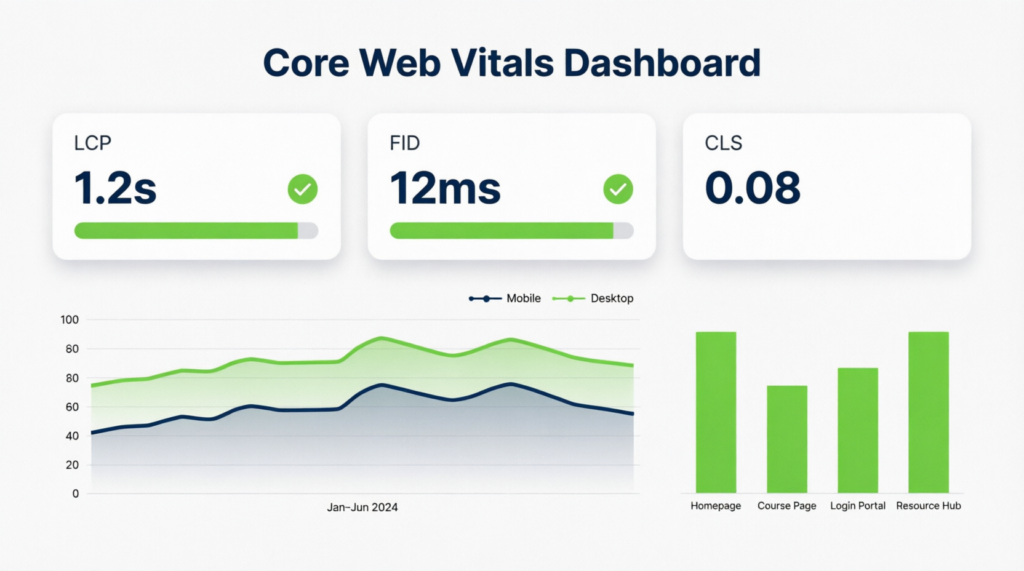
5. Faster Page Load Times and Better Core Web Vitals
A one-second delay in page load time can reduce conversions by 7%, according to Google Search Central (opens in new tab). Modern website development education uk uses next-generation image formats, server-side rendering, and CDN delivery to ensure sub-2-second load times on mobile and desktop — both of which are now direct Google ranking factors.
6. Stronger Brand Identity and Institutional Trust
Your website communicates your institutional values before a single human interaction takes place. Consistent typography, a purposeful colour palette, high-quality photography, and clear messaging all contribute to the trust signals that persuade families to book an open day or submit an application. A professionally developed education site instantly separates your institution from those still relying on 2015-era templates.
7. Integration With MIS, CRM, and Admissions Systems
Modern website development education uk goes beyond design. Your website should connect seamlessly with your Management Information System (MIS), CRM, and admissions portal — whether that’s SIMS, Arbor, SchoolMIS, or a bespoke solution.
How AI-First Website Development Works: A Step-by-Step Process
Discovery & Audit: Analyse your current website performance, user journeys, and competitor landscape using AI-powered audit tools. Identify technical SEO gaps, accessibility failures, and conversion bottlenecks.
Strategy & Architecture: Define your information architecture, target personas (students, parents, governors), and content pillars. Map every page to a specific user intent.
UI/UX Design: Create wireframes and high-fidelity mockups tailored to your brand. Incorporate accessibility standards (WCAG 2.2) from the very first design iteration.
AI Feature Integration: Build and train your AI chatbot on your institutional data. Integrate personalisation engines that adapt content based on user behaviour.
Development & Testing: Build on a robust CMS (WordPress, Craft CMS, or headless architecture). Conduct cross-browser, cross-device, and accessibility testing rigorously.
SEO & Schema Implementation: Implement structured data (JSON-LD), meta tags, and internal linking architecture. Submit your sitemap to Google Search Console and Bing Webmaster Tools.
Launch & Ongoing Optimisation: Monitor performance using Google Analytics 4, Search Console, and AI-driven insights. Iterate monthly based on real data.
Real-World Use Cases: Website Development for UK Educational Institutions
Independent School in Surrey
A Surrey-based independent school was receiving over 2,000 monthly website visitors but converting fewer than 0.8% into open-day bookings. After a full website development education uk rebuild — including AI chatbot, personalised course pages, and mobile-first redesign — their open-day booking rate climbed to 3.2% within three months. That represented 48 additional families per month engaging directly with the admissions team.
Post-16 College in Manchester
A Manchester-based sixth form college struggled with high bounce rates (over 75%) on their homepage. The root causes were a cluttered navigation, slow load times (6.2 seconds on mobile), and no clear call to action. A rebuild prioritising Core Web Vitals, simplified navigation, and a prominent “Apply Now” journey reduced bounce rate to 38% and increased applications by 22% in the first academic year.
Russell Group University in London
A London-based university deployed an AI-powered department landing page system that automatically personalised content based on a visitor’s referring search query. A student arriving from a “data science masters London” search would see different imagery, testimonials, and CTAs than one arriving from “computer science PhD funding UK”. The result was a 31% increase in postgraduate enquiries year-on-year.
Common Mistakes to Avoid in Education Website Development
Building for desktop only: Over 65% of UK students research universities on mobile devices. A desktop-first design is a conversion killer.
Ignoring accessibility: Failing to meet WCAG 2.2 standards exposes your institution to legal action and excludes a significant portion of your audience.
I’m A beautiful website with no search visibility is a digital ghost. Technical SEO must be baked in from day one.
Overloading the homepage: Prospective students need a clear, distraction-free journey. Ten competing CTAs result in zero clicks.
Neglecting page speed: Every extra second of load time costs you enrolments. Optimise images, use a CDN, and eliminate render-blocking scripts.
Not integrating your CRM: Manual data transfer from website enquiry forms to your CRM wastes staff time and loses leads. Automate from the start.
Setting and forgetting: A website is not a one-time project. Monthly monitoring, A/B testing, and AI-driven optimisation are essential for sustained performance.
How Next Source AI Delivers World-Class Website Development for UK Education
Next Source AI is a UK-registered custom AI solutions agency specialising in website development education uk and beyond. We combine deep technical expertise with a genuine understanding of the UK education landscape — from Ofsted frameworks to UCAS application cycles — to build websites that don’t just look good, but perform.
Whether you are a primary school in Yorkshire, an independent college in Edinburgh, or a Russell Group university in London, Next Source AI has the tools, talent, and track record to transform your digital presence. Explore our full range of services — from AI for digital marketing agencies to AI for legal firms — all underpinned by the same commitment to measurable results.
Conclusion & Your Next Step
website development education uk is no longer a nice-to-have — it is the foundation of every successful student recruitment and retention strategy. In 2026, the institutions that invest in AI-first, accessible, and SEO-optimised websites will dominate search, win enrolments, and build lasting reputations. Those that do not will find themselves invisible to the very students they are trying to attract.
Ready to transform your institution’s digital presence? Email the Next Source AI team at hello@nextsourceai.com or visit nextsourceai.com/ai-for-education to book your free AI website audit today. The best time to upgrade your website was last year. The second-best time is right now.
FAQs
Website development education UK involves planning, designing, building, and optimising digital platforms specifically for UK-based educational institutions. In 2026, it also involves connecting your website to CRM, MIS, and admissions systems for seamless data flow.
Costs vary significantly based on scope. A primary school website redevelopment typically ranges from £3,000–£8,000. An independent secondary school site runs £8,000–£20,000. A full university platform with AI features, personalisation, and CRM integration can range from £30,000–£150,000+.
Yes. Public sector educational bodies in the UK must comply with the Public Sector Bodies (Websites and Mobile Applications) Accessibility Regulations 2018, which require WCAG 2.1 Level AA compliance as a minimum. Privately funded schools are strongly advised to follow the same standards to avoid legal risk and to serve all prospective students effectively.
A typical school website project takes 8–16 weeks from initial briefing to launch. More complex university platforms with custom integrations, multiple languages, and AI features may take 16–30 weeks. Proper planning, significantly reduces the likelihood of delays and post-launch fixes.
WordPress remains the most popular CMS for UK schools due to its flexibility, large plugin ecosystem, and affordability. Headless architectures (using Next.js or Nuxt.js with a headless CMS) are increasingly popular for high-traffic institutions prioritising speed and developer control.

